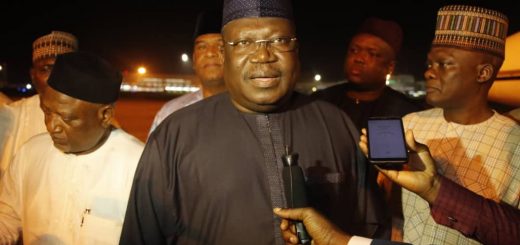
Defence Minister highlights strategic defence management as key to national stability and development

The Minister of Defence, H.E. Mohammed Badaru Abubakar, has stressed the critical role of strategic defence management in safeguarding Nigeria’s sovereignty, maintaining peace, and accelerating socioeconomic development.
Speaking during a lecture at Course 33 of the National Defence College in Abuja, the Minister emphasized that the Ministry of Defence occupies a central role in navigating Nigeria’s complex and evolving security landscape. The lecture, titled “Strategic Defence Management in Nigeria: Ministry of Defence in Perspective,” offered insights into how the Ministry is adapting to current security realities through institutional reforms, strategic foresight, and inter-agency collaboration.
Badaru commended President Bola Ahmed Tinubu for placing national security at the forefront of his administration’s agenda. He said the President’s leadership is reinforcing the vital link between security and development through reforms focused on military capacity building, modernization, and increased investment in indigenous defence production.
Addressing the current security challenges, the Minister outlined Nigeria’s diverse threat environment—from insurgency in the North-East to banditry and communal violence in the North-West and North-Central, secessionist agitations and oil theft in the South, and maritime threats in the Gulf of Guinea. He also drew attention to the ripple effects of regional instability in the Sahel and Nigeria’s strategic role within ECOWAS and the African Union in formulating broader defence policies.
“The security environment in Nigeria is shaped by a complex interplay of state actors, non-state insurgents, civil society, media influences, and foreign interests,” he said. “Strategic defence management must rise to this complexity by aligning defence priorities with national interests and global dynamics.”
Badaru underscored the Ministry’s mandate to formulate and implement the National Defence Policy, maintain military readiness, and lead strategic initiatives that integrate defence planning, policy execution, and resource management. He called for a forward-looking, multi-dimensional approach to defence that embraces both traditional military capabilities and non-kinetic strategies.
He also reaffirmed the Ministry’s commitment to enhancing operational efficiency, deepening transparency, and fostering partnerships across government institutions, civil society, and the private sector. “Security should not be the burden of the military alone,” the Minister said. “We need a whole-of-government and whole-of-society approach that leverages military, economic, and diplomatic tools to secure our future.”
In his response, the Commandant of the National Defence College, Rear Admiral James Ohimai Okosun, thanked the Minister for delivering what he described as a timely and thought-provoking lecture. He lauded the ongoing defence reforms under Badaru’s leadership, noting that they are raising the bar for institutional effectiveness and leadership training across Nigeria’s security architecture.
The lecture served as part of the College’s broader effort to prepare senior officers for strategic leadership roles in an increasingly volatile security environment, reinforcing the importance of policy-driven military education in national defence planning.